
The artificial intelligence (AI) revolution is sweeping across Southeast Asia (SEA), and Thailand is keeping pace with this transformation. While major corporations are keen to integrate AI to streamline operations, a new generation of Thai startups is driving innovation by embedding AI into existing services to serve both businesses and end users.
This article will guide you through:
- Thai User Behavior: How both end users and business users are adopting AI.
- The Role of Thai Startups: How they are facilitating AI adoption.
- Benefits to the Thai Economy: The broader economic advantages of AI.
Broader SEA Context: Thailand’s 🐘 Role in Advancing AI Revolution
Thailand’s AI market is projected to grow at an annual rate of 28.55%, with an estimated market value of 114 billion baht by 2030. This growth is fueled by a widespread adoption of AI across various sectors, from finance and healthcare to manufacturing and e-commerce. Government initiatives like the National AI Strategy and the Digital Thailand Plan are laying the groundwork for a robust AI ecosystem by investing in talent development and infrastructure. The government is also working on a balanced regulatory framework, with draft laws that both encourage innovation and establish ethical guidelines for AI use.
This approach positions Thailand as a strategic hub, not just for local growth but also for regional collaboration. The focus on developing a localized AI infrastructure, including small language models (SLMs) tailored to the Thai language and culture, gives Thai startups a competitive edge in serving the local market and potentially expanding to other SEA countries.
Thai User Behavior: How both end users and business users are adopting AI
👤End Users
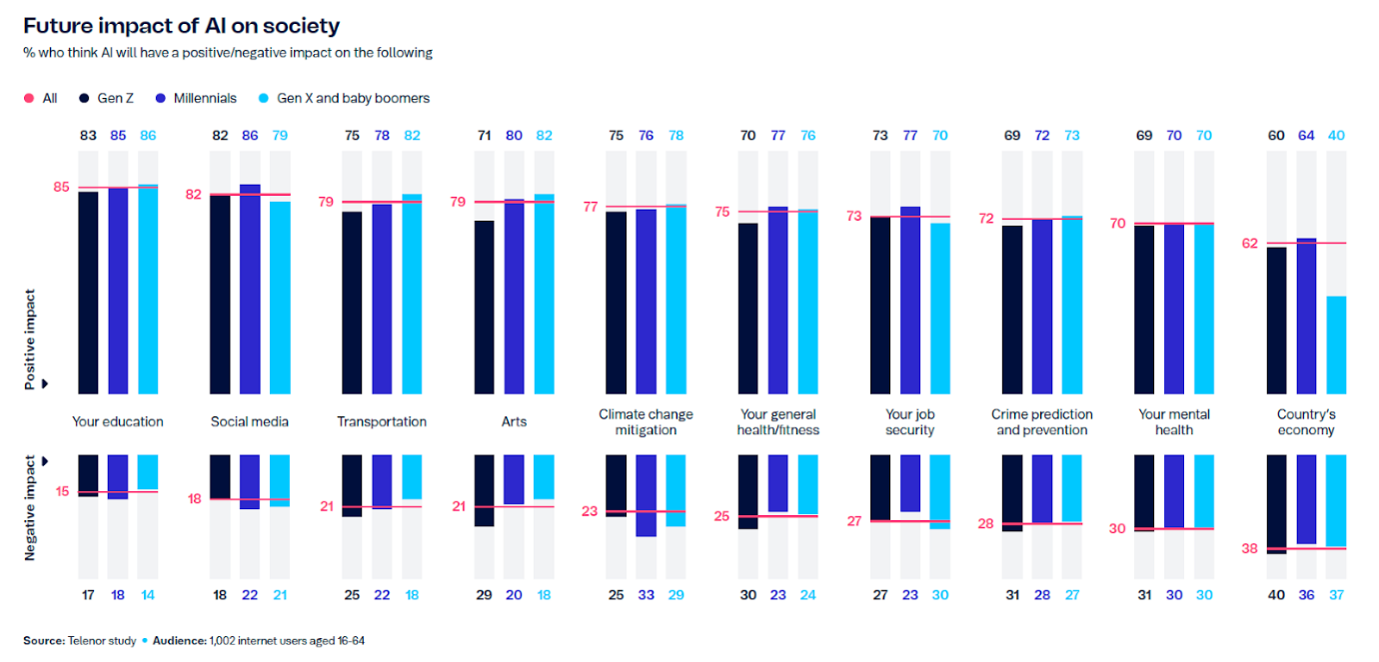
Telenor Asia conducted a survey evaluating Thai’s perception on AI, and 3 out of 4 respondents are already using AI tools. Eighty percent of respondents believe AI has a positive impact especially in education and soc
ial media. Fifty percent of internet users trust information generated by AI.
Thai internet users, according to Telenor Asia, spend on aver
age, 5 hours online daily on mobile, which is 1.5 hours more than average spending by Southeast Asian
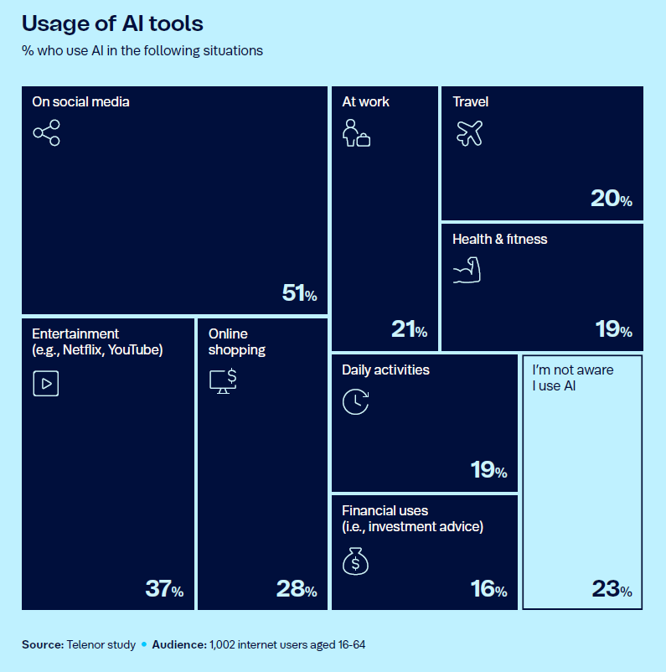
The high rates of AI tool usage, combined with a positive perception and strong digital engagement among the public, indicate strong growth and adoption of AI technologies. However, the lack of widespread trust in AI-generated content is still challenging to overcome. For Thailand to truly solidify its position as an AI hub, it must not only foster innovation but also actively work to build public confidence in the reliability and ethical use of AI. This suggests that while the “demand side” is strong, building the “trust and data privacy” infrastructure is a crucial next step.
💼Businesses
Based on a survey by IT market research firm IDC, titled ‘IDC Asia/Pacific Enterprise Cognitive/AI,’ Thailand ranks second to Indonesia in terms of AI adoption. Indonesia leads the ASEAN region with 24.6% of organizations adopting the technology, while Thailand accounts for 17.1%. Singapore is third with 9.9%, followed by Malaysia at 8.1%. AI adoption in Indonesia is primarily driven by major technology companies like Go-Jek, a ride-hailing and online payment giant, and Kaskus, the country’s largest forum and marketplace.
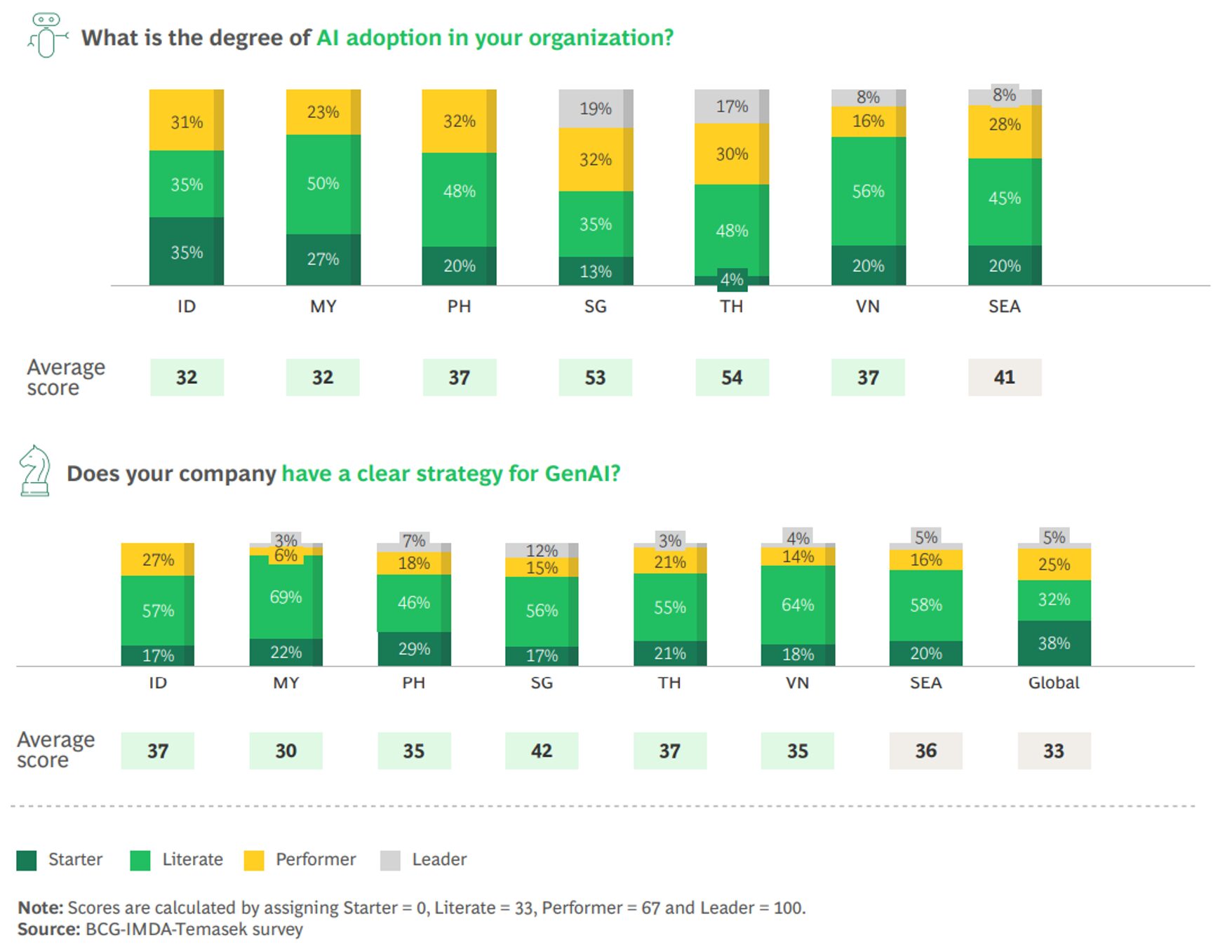
Similarly, a report by BCG on “Unlocking Southeast Asia’s AI Potential” shows that companies from Singapore, Indonesia, and Thailand rated themselves highly for their AI strategy-setting. Thailand and Singapore are emerging as regional frontrunners in AI adoption, driven by clear strategies and increasing investments in technology and talent. Although not in the top position in all aspects, Thailand is considered one of the top three in terms of AI adoption in a business context.
PWC Thailand predicts a rise in generative AI (GenAI) integration in business strategies. Vilaiporn Taweelappontong, Asia Pacific Financial Services Consulting Leader and Consulting Lead Partner at PwC Thailand, said
“In 2025, GenAI will advance and be utilized more seriously and widely to achieve business strategies. Last year, the sentiment towards GenAI in the Thai market was positive. We’ve seen many organizations integrate this technology across several areas, such as content creation, personalized marketing, customer support, games and entertainment development, and education,”
While large corporations are embracing AI, the widespread adoption of artificial intelligence (AI) among Thailand’s Small and Medium Enterprises (SMEs) is crucial for boosting operational efficiency and driving the national economy. With more than 3.2 million SMEs, these businesses constitute 90% of the country’s enterprises and employ half of the workforce. Today, the SMEs awareness of AI adoption is improving, despite ongoing concerns on cost of adoption and workforce readiness.
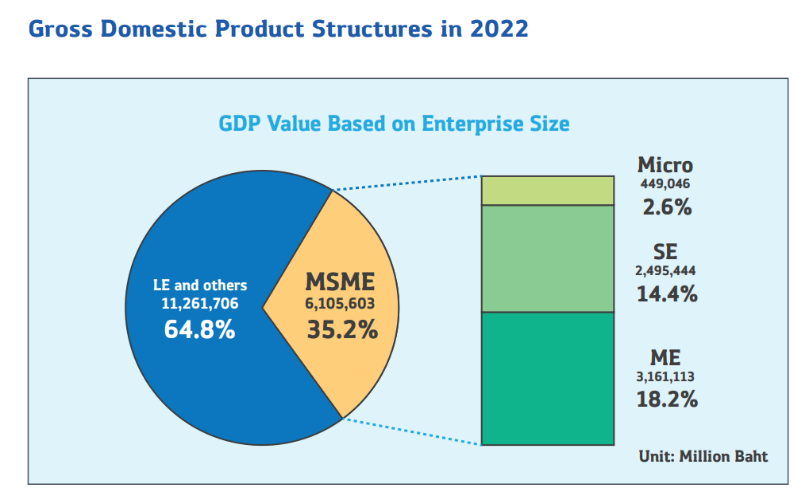
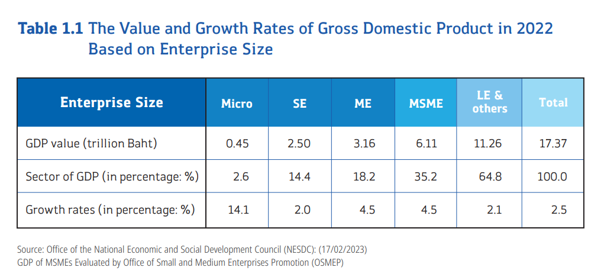
Given the strong drive for AI adoption among enterprises and the immense potential benefits for SMEs, Thai startups can play a crucial role in bridging this gap. By offering ready-to-use, “quick-win” solutions to enterprises and providing easily embedded services for SMEs, these startups enable businesses of all sizes to seamlessly integrate artificial intelligence into their operations and business strategies.
Thai end users are primarily using generative AI for personal use and productivity. While business-related use cases may take more time to fully adopt, due to a need for increased AI literacy, research suggests that both Thai people and businesses are very open to further AI adoption and keen to realize its potential benefits.
The Role of Thai Startups🛺: How they are facilitating AI adoption
Thai startups are at the forefront of AI adoption, actively integrating this technology to gain a competitive edge. According to the National Innovation Agency (NIA), Thailand has 800 active startups out of a total of 2,100, with a high concentration in Fintech and Business Solutions.
Beyond using AI for efficiency and cost savings, these startups are leveraging it to better serve customers and improve user experience, which helps them gain a stronger competitive advantage and brand perception. The approach to AI adoption varies significantly depending on the client:
- 👤For End Users (Individuals): AI adoption focuses on simplifying complex tasks and personalizing experiences. The AI is often actively operating in the background, or presented as a user-friendly feature. A prime example is Jitta’s platform, which makes sophisticated investment analysis accessible to everyday people. Similarly, food delivery platforms like LINE MAN use AI recommendation engines to analyze a user’s past orders and preferences, offering personalized suggestions for dishes and restaurants to enhance their experience and increase sales
- 👨💼For Small and Medium Enterprises (SMEs): AI is adopted to boost operational efficiency and automate workflows with limited staff. A prime example is FlowAccount’s AutoKey feature, which uses OCR technology to automate data entry from bills and receipts, saving significant time for SMEs. Another example is ZWIZ.AI, a Thai startup that offers an AI chatbot platform to help SMEs automate customer service, manage sales, and analyze customer data across social media channels, enabling them to handle customer interactions and sales around the clock.
- 🏢For Large Corporations: AI is integrated to enable strategic decision-making and optimize complex operations at a large scale. Primo’s “Bai Toey”, for instance, is an AI agent built on a Loyalty CRM system that excels at providing strategic analysis and recommendations by simplifying complex data for marketing teams. Another example for AI for marketing, ConnectX is a Customer Data Platform (CDP) that focuses on integrating and unifying customer data from multiple sources to enable real-time personalized marketing and automation.
The benefits of AI are extensive, primarily revolving around enhanced efficiency, data-driven decision-making, and fostering innovation. By automating repetitive tasks, AI frees up human resources to focus on creative and strategic work. Its ability to analyze vast datasets provides insight into business strategies and personalization. Furthermore, AI could act as a catalyst for a company’s reputation, positioning it as an innovative and differentiated leader in its field.
Arguments Against AI Adoption 💢📣
AI adoption, while promising, also presents specific challenges depending on the client. Here’s a breakdown of the key arguments against AI adoption for different client segments:
For End Users (Individuals) 👤
- Trust and Credibility: The primary challenge is a lack of trust. According to a Telenor Asia survey, only half of Thai internet users trust AI-generated information. This is often linked to AI “hallucinations,” where the system produces plausible but completely false data. This inherent unpredictability makes users hesitant to rely on AI for critical decisions like financial or health planning, given the “black box” nature of the technology.
- Privacy Concerns: As AI tools become more personalized, they require access to personal data. Users may be concerned about how their data is collected, stored, and used, especially if the service is a free or low-cost application.
- Digital Literacy: While many Thai people are digitally engaged, a lack of deep digital literacy could lead to misuse of AI tools or an over-reliance on AI-generated information without proper verification.
For Small and Medium Enterprises (SMEs) 👨💼
- Cost and Complexity: For SMEs with limited budgets, the initial investment in AI-embedded solutions can be a significant barrier.
- Talent Gap: SMEs often lack the in-house talent to manage, troubleshoot, or customize AI systems. They may be entirely dependent on the software provider for support, which can be costly and slow.
- Over-reliance and Loss of Expertise: The automation provided by AI could lead to a dependency on the technology, potentially eroding the in-house expertise of the SME’s workforce.
For Large Corporations 🏢
- Integration Challenges: Large corporations typically have complex legacy systems. Integrating new AI technologies into these existing systems can be a massive technical challenge, leading to high costs, delays, and operational disruptions.
- Data Security and Governance: With the immense scale of data that corporations handle, using AI raises significant concerns about data security, privacy, and compliance. A breach in an AI system could expose millions of customer records, leading to severe financial and reputational damage.
- Ethical and Bias Issues: AI models can perpetuate and amplify existing biases, leading to discriminatory outcomes and significant brand risk. This is further complicated by “hallucinations” in GenAI, where a system can produce entirely fabricated information. The combination of these issues—bias and hallucinations—poses a dual risk, as decisions could be based on flawed or nonexistent data, severely impacting a company’s reputation and bottom line.
- “Black Box” Problem: For corporate leaders, making decisions based on AI outputs can be difficult if they don’t understand the underlying logic. This lack of transparency can lead to a trust issue within the organization, making it harder to get buy-in for AI-driven strategies.
Takeaways ✏️ for Startups Serving AI Solutions to Different Client Segments
From a business perspective, the debate about adopting AI for a startup in Thailand revolves around distinct advantages in terms of market strategy, resource allocation, and scalability. The “better” choice depends on a business’s specific goals, resources, and target market.
To effectively meet the diverse needs of different clients, startups must tailor their approaches for individual, SME, and corporate customers.
| End Users👤 | SMEs👨💼 | Large Corporations🏢 | |
| Product Strategy | The AI is often actively operating in the background or presented as a smart, user-friendly feature. Users can naturally use AI with or without downloading a new app. | The AI should be an “embedded” service or “plug-and-play” within an existing workflow, providing immediate and clear ROI with low implementation risk. | The AI must be designed to handle large datasets, integrate with existing enterprise systems, and provide actionable insights that enable strategic decision-making. Startups should focus on the ROI, efficiency gains, and long-term strategic value the AI provides. |
| Pricing Strategy | Use simple, transparent pricing models like freemium or low-cost subscriptions. | A tiered, subscription-based (SaaS) model is ideal to make the service accessible and scalable. | Pricing is typically custom and value-based, reflecting the significant benefits provided to the corporation. |
| Selling Points | Trust and Creditability | Cost and Simplicity | Security, Explainability, and Long-term Value Creation |
| Startup Examples | Jitta is a prime example. Its AI platform is designed for individual investors, allowing them to make informed investment decisions without needing to be financial experts. Tools like Jitta Score and Jitta Line simplify complex financial analysis, making sophisticated investment strategies accessible to the everyday person. | FlowAccount successfully targets the SME segment. Its AI-embedded AutoKey feature uses OCR technology to automate data entry from physical receipts. This solves a major pain point for SMEs by saving a significant amount of time and effort for business owners and accountants, allowing them to focus on more strategic tasks. | Primo’s “Bai Toey” Agentic AI is designed for large enterprises, it serves as an intelligent assistant for marketing and CRM teams. It can analyze huge datasets, summarize complex insights (like customer churn probability), and provide strategic recommendations. This level of AI is not just about efficiency; it’s about enabling a corporation to make more intelligent and proactive business decisions. |
Benefits to the Thai Economy📈💸: The broader economic advantages of AI
A report by Access Partnership indicates that the adoption of AI could unlock at least 2.6 trillion Thai baht in economic benefits for Thailand’s businesses by 2030, which represents 15% of the total AI opportunity for Southeast Asia.
The widespread adoption of AI by Thai startups is not just a technological trend; it is a powerful engine for national economic growth and a key factor in positioning Thailand as a leader in Southeast Asia.
- Empowering SMEs as the Economic Backbone: With over 3.2 million SMEs accounting for 90% of all businesses and employing 50% of the workforce, their productivity is directly tied to the health of the Thai economy. AI-embedded solutions, like FlowAccount’s AutoKey, provide these businesses with accessible tools to automate manual tasks, boost operational efficiency, and free up resources to focus on growth.
- Boosting National Productivity: By automating repetitive processes across various industries—from accounting and customer service to manufacturing and logistics—AI can significantly increase national productivity. This allows businesses to do more with less, leading to higher output and improved competitiveness in both domestic and international markets. For example, LINE MAN Wongnai leverages AI to optimize its vast delivery network, using machine learning to plan the most efficient routes for its fleet of riders and ensure timely deliveries.
- Fostering Innovation and New Industries: AI-native startups are creating entirely new business models and industries. Jitta, for example, is not just a tech company; it is building a new financial services sector that democratizes sophisticated investment strategies. This kind of innovation attracts foreign investment, creates high-value jobs, and diversifies the national economy beyond traditional sectors.
- Attracting Talent and Becoming an AI Hub: The high rates of AI adoption and positive public perception of the technology, coupled with significant digital engagement, create a fertile ground for AI innovation. As Thai startups succeed, they build a reputation for the country as a dynamic tech hub. This, in turn, attracts global talent and capital, further accelerating the growth of the AI ecosystem and solidifying Thailand’s position as a regional leader in the digital economy.
The benefits of AI adoption to Thai economy are significant. The AI could boost economic value, industry-specific benefits, and broader societal and environmental impact. To successfully navigate Thailand’s growing AI landscape, startups must recognize that a one-size-fits-all approach is no longer effective. The key lies in a nuanced understanding of their target clients and a tailored strategy to meet their distinct needs and concerns. Ultimately, solutions must solve pain points and create tangible value for customers. Successful startups must continuously adapt to serve the evolving and growing needs of their clientele.
Sources:
https://www.telenorasia.com/digital-lives-decoded/thailand-pressrelease/
https://www.pwc.com/th/en/press-room/press-release/2025/press-release-31-01-25-en.html