In today’s competitive landscape, businesses are relentlessly seeking ways to reduce costs and boost productivity. This inherent limitation has fueled a significant demand for advanced tools and technologies that can push these boundaries.
The current technological landscape, marked by advancements in Large Language Models , sophisticated data digitization, and increased inter-sector cooperation on data usage, has given rise to a new concept within the SaaS community: AI in SaaS. This innovative approach can be broadly categorized into two distinct types: Horizontal AI SaaS and Vertical AI SaaS.
Given that traditional SaaS solutions, while valuable, often fall short in addressing the substantial burden of labor costs due to their reliance on human intervention, this article strategically zeroes in on the transformative potential of Vertical AI SaaS. Unlike its horizontal counterpart, Vertical AI SaaS offers a specialized and deeply integrated approach, uniquely positioned to leverage AI advancements to automate labor-intensive tasks and workflows within specific industries. This focused application allows for a much deeper level of cost reduction and productivity gains, thereby moving beyond the limitations of generic tools to fundamentally reshape operations in labor-intensive sectors.
The emergence of advanced AI, particularly LLMs, offers a significant leap in enhancing traditional SaaS capabilities. Key features like natural language processing (NLP) allow SaaS platforms to understand and generate human-like text, enabling sophisticated chatbots for 24/7 customer support, automated content creation for marketing and sales, and intuitive conversational user interfaces. Furthermore, machine learning and predictive analytics can transform traditional SaaS by analyzing vast datasets to forecast trends (e.g., customer churn, sales, product demand), personalize user experiences by adapting interfaces and recommendations in real-time, and identify anomalies for fraud detection or security enhancements. These AI-driven features move beyond simple automation to provide intelligent decision support, proactive insights, and adaptive functionalities, making traditional SaaS applications more efficient, responsive, and ultimately, more valuable to users.
Horizontal vs. Vertical AI SaaS: A Tale of Two Approaches
To understand the transformative potential of Vertical AI SaaS, it’s crucial to differentiate it from its horizontal counterpart.
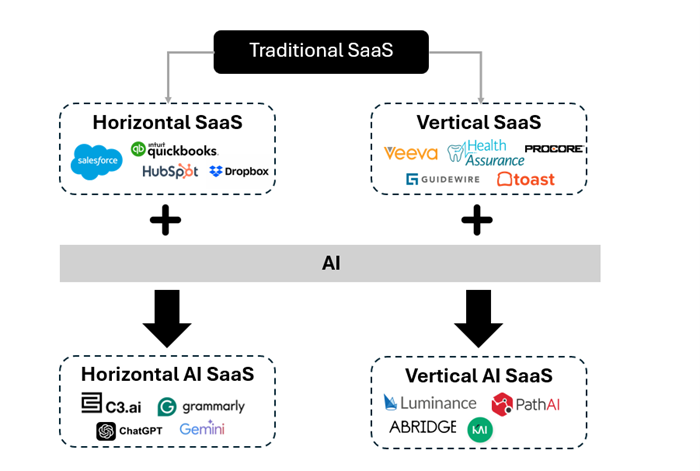
Horizontal AI SaaS refers to general-purpose AI designed to function across multiple industries and business functions. These solutions prioritize broad automation and intelligence rather than being specifically tailored to the unique needs of a single industry. Examples include:
- Chatbots e.g. ChatGPT and Gemini : providing powerful general-purpose AI models that can be integrated into various applications for customer service, content creation, research etc.
- C3.ai: an AI platform that allows organizations to build, deploy, and operate AI applications at scale, integrating machine learning, big data, and cloud computing. Its clients are in several industries including manufacturing, oil and gas, financial services, healthcare, transportation etc.
- Grammarly: an AI-powered writing assistant that helps users improve grammar, spelling, punctuation, clarity, engagement, and delivery in their writing across various platforms that could be used in many sectors such as education, business, and marketing.
Vertical AI SaaS is purpose-built AI designed for a specific industry or function. Its core purpose is to address the distinct challenges, workflows, and regulatory requirements inherent to a particular sector. Notable examples include:
- KAI for Banking: a conversational AI platform developed by Kasisto specifically for the banking and finance industry. It aims to enhance customer experience by providing personalized, human-like interactions through virtual assistants and chatbots.
- Luminance: an AI-powered platform for legal document review and contract analysis. It helps legal professionals rapidly review, understand, and negotiate contracts by highlighting key terms, clauses, and anomalies, improving efficiency in due diligence and compliance.
- PathAI: an AI-powered pathology tool for diagnosing diseases, particularly cancer. Their AI analyzes digital images of tissue samples to assist pathologists in identifying anomalies and making more accurate and efficient diagnoses.
- Abridge: provides AI to help generate structured medical notes and summaries directly from doctor-patient conversations. This frees up clinicians from extensive documentation, allowing them to focus more on patient care. It also helps ensure accurate coding and billing.
Historically, most traditional SaaS offerings have resided in the horizontal space, favoring quick scalability and a larger total addressable market (TAM). Vertical SaaS, due to its niche market and more limited TAM, has consequently received less investor attention. However, the recent maturation of LLMs and significant advancements in AI have unlocked tremendous value in vertical SaaS. This is primarily achieved by drastically reducing labor costs through AI-driven workflow replacement and by enabling solutions previously unattainable with traditional SaaS.
The Transformative Power of AI in Vertical SaaS
AI significantly enhances the value proposition of vertical SaaS by transforming traditional industry-specific software into powerful, intelligent solutions. This is primarily achieved through several key mechanisms:
- Profound Labor Cost Reduction: Vertical AI can automate entire, complex workflows specific to an industry, often replacing highly-paid professional roles. This goes beyond simple task automation; it aims to eliminate the need for entire teams, leading to substantial cost savings. In contrast, while horizontal AI does reduce costs, it typically targets more generic tasks with lower associated labor expenses.
- Improve Workflow Efficiency and Enhance New Capabilities: AI empowers vertical SaaS to offer capabilities that were previously unattainable. This includes advanced analytics, predictive insights, and sophisticated decision-making tools that integrate seamlessly into existing industry workflows. By introducing these intelligent features, vertical AI not only streamlines operations but also enables new levels of performance and insight.
- Improve Customer Acquisition and Retention: While horizontal AI often incurs higher customer acquisition costs due to its broad targeting, vertical AI benefits from a more focused approach. Its ability to deeply solve industry-specific “pain points” can lead to stronger customer loyalty and more efficient go-to-market strategies.
In essence, AI supercharges vertical SaaS by enabling deeper automation, providing more precise solutions, and fundamentally enhancing the overall value proposition for specialized industries. The advent of AI has dramatically reversed the historical perception of vertical SaaS as less appealing, potentially leading to a larger TAM that could attract more startups and investors into this space.
Vertical AI vs. Horizontal AI
As Vertical AI has demonstrated strong potential to grow, it is worth diving deeper into how it plays differently from Horizontal AI. The table below highlights the key distinctions between these two types of AI SaaS, offering insights into their market approaches, development considerations, and exit opportunities.
|
Feature
|
Vertical AI |
Horizontal AI |
| Nature of TAM |
- TAM: Smaller in absolute terms, but higher market share potential within the niche.
- Limited to specific industries (limited Q)
- [Value-based pricing] Value to be captured is large, depending on the potential cost-saving that automation can unlock or new revenue generation potential (potentially large P)
- Ease of upsell (increase P)
Depends on the potential cost-saving that automation can unlock and new revenue streams it can help generate (previously impossible or too expensive with human labor alone). |
- TAM: Potentially very large, but intense competition for market share.
- Broad across different industries with similar needs (Large Q)
- [Standardize pricing] Value to be captured depends on discretionary budget for the specific task (Small P)
- Difficulty in upselling
Depends on the number of industries and clients such horizontal AI can scale to.
|
| Growth Model |
Stay in the same industry but increase revenue per client (higher LTV). Scalability is limited to one industry. |
Offer the same solutions across several industries. Easy to scale as industry-specific customizations are not required. |
| Competitive Edge |
Vertical AI companies compete on deep domain expertise beyond general industry knowledge and seamless integration. |
Horizontal AI companies compete on how fast they can scale to new industries and acquire new clients. |
| Barrier to Entry |
High barriers to entry for new competitors due to deep industry expertise, data moats, and specific industry regulations. |
Low barriers to entry due to their generic nature. |
| Development Cost |
Higher due to the requirement to use industry-specific datasets for improved decision-making. |
Lower development costs. |
| Exit Opportunities |
Acquired by industry incumbents. |
Acquired by horizontal SaaS incumbents. |
While Horizontal AI SaaS products serve similar needs across multiple industries, Vertical AI solutions are tailored for specific sectors. The key question is which industries will become early adopters. Our research indicates that these early adopters share common characteristics: they face significant pain points that traditional SaaS has been unable to solve, which Vertical AI is uniquely positioned to address.
Prime Candidates for Vertical AI SaaS Adoption
Not all industries are equally ripe for the adoption of Vertical AI SaaS. The most promising candidates exhibit certain characteristics:
- Industries demanding precision and compliance: Sectors like legal services, healthcare, and finance require AI tools with specific industry knowledge, data, and regulatory adherence. Hallucination and misinformation make generic AI untrustworthy where accuracy and explainability are paramount.
- Industries with high labor costs or talent limitations: Especially those relying on highly trained professionals, stand to gain significantly from AI-driven aon.
Identifying the right industries is only the first step. The real opportunity—and the key to building the next unicorn—is understanding what makes a vertical AI solution truly indispensable. Moving beyond potential, we now turn our attention to the essential ingredients and strategic elements that will determine the next vertical AI winner.
Ingredients for the Next Vertical AI Winner
Building a successful Vertical AI SaaS company requires a specific combination of attributes:
Pre-requisite Characteristics:
- Proprietary Data & Strong Data Strategy: Companies must be able to ethically acquire, clean, and leverage unique datasets for training their AI models. This data acts as a crucial differentiator and a formidable moat.
- Focus on High-Value Automation/Augmentation: Targeting tasks that are repetitive, high-cost, critical, or require specialized knowledge ensures clear ROI. The solution must demonstrate measurable impact on efficiency, cost savings, revenue generation, or risk reduction.
Beyond Pre-requisites:
- Deep Domain Expertise: Unicorns in this space don’t just understand an industry; they grasp its granular, nuanced workflows, specific jargon, regulatory complexities, and unaddressed pain points that general AI solutions miss. This profound understanding is critical for building truly effective and tailored solutions.
- Seamless Integration into Existing Systems and Processes: AI solutions must plug directly into the existing software and workflows that teams already rely on, minimizing disruption and maximizing usability. Frictionless integration is key to adoption and long-term success.
- Task-Specific Logic: Incorporating industry-specific workflows and decision-making logic that align with established processes ensures the AI solution can seamlessly support complex, role-specific tasks. This ensures the AI acts as an intelligent assistant, not a disruptive force.
- Expertise in Selling to Clients: Potential clients for Vertical AI SaaS are often , accustomed to traditional ways of working. The sales team must be adept at convincing these clients to embrace new technologies and clearly demonstrate tangible benefits such as cost reduction, improved efficiency, and increased profits.
Now that we’ve covered the ingredients for a successful Vertical AI solution, let’s bring these concepts to life. The next section will delve into real-world use cases that demonstrate the tangible value of this technology.
Real World Use Case
To illustrate the potential of vertical AI SaaS, consider Planet FWD, a San Francisco-based private company founded in 2019, as an example. Operating in the Environmental Services (B2B) industry, Planet FWD provides a carbon management platform specifically for consumer brands in the food and retail sectors. This platform leverages AI to empower clients to measure, reduce, and report their carbon footprint, offering AI-powered Life Cycle Assessments (LCAs), corporate inventory management, and tools for Scope 3 decarbonization, all supported by a comprehensive dataset tailored for the consumer goods industry.
Traditionally, brands seeking carbon management relied on consultants for laborious, multi-month processes involving data collection, carbon emission calculations, and reporting, with timelines extending significantly for clients with numerous products.
Planet FWD’s AI integration revolutionizes this by providing quick and highly accurate product LCA, drastically reducing the time and human intervention required. This automation replaces the need for costly consultants and streamlines the entire process. Beyond measurement, Planet FWD’s AI algorithms also provide actionable recommendations for carbon reduction, such as suggesting alternative raw materials and sourcing. This capability, once a challenging and research-intensive task for consultants, unlocks new revenue streams for Planet FWD and offers unparalleled value to its clients.
Conclusion
The advent of AI marks a significant evolution in the SaaS landscape, moving beyond the limitations of traditional software to create powerful, intelligent solutions for specialized industries. While traditional SaaS and Horizontal AI have their place, they often fall short in addressing the deep-seated, industry-specific pain points and substantial labor costs that Vertical AI is uniquely positioned to solve. The transformative power of can achieve by offering specialized, deeply integrated, and highly effective solutions for specific industries. As demonstrated, Vertical AI not only dramatically reduces labor costs through automation of complex workflows but also unlocks previously unattainable capabilities, leading to profound improvements in efficiency and customer value. While Horizontal AI will continue to play a crucial role in broader applications, the future of specialized industries lies in the targeted intelligence and deep domain expertise offered by Vertical AI solutions. Companies that embrace the prerequisites and key success factors outlined—from proprietary data and high-value automation to deep domain expertise and seamless integration—will be best positioned to lead this new era of AI-driven transformation, exemplified by innovative solutions like Planet FWD. The ongoing evolution of AI, particularly LLMs, ensures that Vertical AI SaaS will continue to reshape industries, driving unprecedented cost reductions, productivity gains, and strategic advantages for early adopters and innovators .
References
- https://www.linkedin.com/pulse/vertical-ai-future-saas-20-adhiguna-mahendra-3bwkc/
- https://www.wisp.blog/blog/whats-horizontal-saas-in-ai
- https://www.bvp.com/atlas/part-i-the-future-of-ai-is-vertical
- https://startupstechvc.beehiiv.com/p/the-rise-of-vertical-ai-why-industry-specific-ai-startups-are-the-real-opportunity
- https://medium.com/included-vc/the-next-trillion-dollar-opportunity-why-vertical-ai-is-the-future-of-saas-b7119614cee5
- https://www.greenfield-growth.com/blog-posts/vertical-ai-is-here-how-to-capture-the-opportunity-and-win-big
- https://www.av.vc/blog/venture-deep-dives-vertical-saas-in-the-ai-era
- https://medium.com/@taliehrohani/horizontal-vs-vertical-why-your-ai-product-strategy-needs-a-direction-2e53cd7dfc82